
Imagine a potential customer searching Google for a product or service your business offers. They are already interested. They may be comparing options, researching prices, reading reviews, or looking for a company they can trust.
Now ask yourself: Will they find your business?
Having a website is no longer enough. Your business needs to be visible when your target audience is actively searching for what you offer. This is where SEO in 2026 becomes an essential part of a successful digital marketing strategy.
Search engine optimization, or SEO, is the process of improving your website and content so that search engines can better understand your pages and users can discover your business through relevant searches. Google describes SEO as helping search engines understand your content and helping users find your website through search.
For small businesses in particular, SEO can provide a way to compete for attention without depending entirely on paid advertising. A well-planned SEO strategy can increase visibility, attract relevant visitors, build credibility, and support long-term business growth.
But why is SEO so important in 2026?
Let’s explore the reasons.
1. Your Customers Are Searching Online
The buying journey often begins with a search.
A customer might search for:
- “best digital marketing agency”
- “SEO company for small business”
- “restaurants near me”
- “best accounting services”
- “web design company”
- “affordable marketing agency”
If your website does not appear when potential customers search for services related to your business, you could be losing opportunities to competitors.
SEO helps businesses improve their chances of appearing for relevant searches. Instead of waiting for customers to discover your brand by chance, you can build content and website pages around the questions, problems, products, and services your audience is already searching for.
This is why SEO should not be treated as an optional marketing activity. It should be part of your overall digital marketing strategy.
At Brands Barks, SEO is one part of a broader growth-focused approach that can work alongside paid advertising, content, social media, lead generation, and other digital channels.
2. SEO Can Bring Consistent Organic Traffic
One of the biggest benefits of SEO is its ability to generate organic search traffic.
Unlike paid advertising, where traffic generally depends on an active advertising budget, organic search visibility can continue bringing visitors after your content has been published and optimized.
That doesn’t mean SEO is free or that results happen overnight. SEO requires research, content creation, technical improvements, optimization, monitoring, and ongoing updates.
However, the long-term potential makes it valuable.
For example, suppose you create a useful page targeting a specific service your customers frequently search for. If that page gradually gains visibility and rankings, it can bring relevant visitors month after month.
This creates an opportunity to build a sustainable source of traffic rather than relying entirely on temporary campaigns.
Google also notes that SEO changes can take time to show an impact, with some changes taking weeks or even months to be reflected in Search results.
That is why businesses should view SEO as a long-term investment rather than a quick marketing trick.
3. SEO Helps Small Businesses Compete
Large companies often have bigger advertising budgets, larger teams, and greater brand recognition.
Does that mean a small business cannot compete online?
Not necessarily.
A focused SEO strategy for small businesses can target specific audiences, locations, services, and search queries where larger competitors may not be as relevant.
For example, instead of trying to rank for an extremely broad keyword such as “marketing,” a small agency might create useful content around specific searches such as “SEO services for local businesses” or “digital marketing agency for startups.”
This creates a more focused strategy.
Long-tail and specific search queries can also help businesses attract people who know exactly what they need.
The goal isn’t simply to generate the largest possible amount of traffic.
The goal is to attract the right traffic.
A hundred visitors who are genuinely interested in your service can be more valuable than thousands of visitors who have no intention of becoming customers.
4. SEO Builds Trust and Credibility
Think about your own search behavior.
When you search for a business, you probably feel more comfortable with a company that has a professional website, useful information, clear service pages, helpful articles, and a strong online presence.
SEO contributes to that experience.
When your website consistently appears for relevant searches and provides useful answers, customers can become more familiar with your brand.
Good SEO is therefore about more than keywords.
It includes:
- Useful and original content
- Clear website structure
- Relevant internal links
- Descriptive page titles
- Helpful headings
- Optimized images
- Mobile-friendly experiences
- Fast and accessible pages
- Accurate business information
- Strong user experience
Google’s current Search Essentials emphasize helpful, reliable, people-first content and recommend using words people actually search for in important parts of a page.
In other words, SEO and user experience should work together.
5. SEO Helps You Reach Customers at Different Stages
Not every customer is ready to buy immediately.
Some people are just discovering a problem.
Others are researching possible solutions.
Some are comparing providers.
Others are ready to make a purchase.
SEO allows businesses to create content for different stages of this journey.
For example:
Awareness
A customer searches:
“Why is my website not getting traffic?”
A helpful educational blog can introduce them to SEO.
Consideration
They then search:
“SEO vs Google Ads: which is better?”
A comparison article can help them understand their options.
Decision
Finally, they search:
“SEO agency for small business.”
A strong service page can introduce them to your company.
This creates a connected journey from information to consideration and eventually to conversion.
For businesses looking to strengthen this process, effective lead generation can help turn website visitors into qualified prospects rather than simply generating traffic. Brands Barks offers lead-generation strategies designed around targeted campaigns, funnels, landing pages, and conversion tracking. lead generation services
6. SEO Is Becoming More Important as Search Evolves
Search is changing rapidly.
People are no longer interacting with search engines in exactly the same way they did several years ago. Search experiences are becoming more visual, conversational, personalized, and increasingly influenced by artificial intelligence.
That does not mean SEO is disappearing.
In fact, Google published new guidance in 2026 specifically explaining how website owners can optimize for generative AI features in Google Search. Google states that SEO best practices remain relevant and foundational to success in these AI-powered search experiences.
The important change is that businesses need to focus even more on creating genuinely useful content.
Instead of producing pages simply to insert keywords, businesses should answer real questions, demonstrate expertise, provide original information, and make their websites easy to understand.
The future of SEO is not about tricking search engines.
It’s about becoming the best answer for the right audience.
7. SEO Supports Your Other Marketing Channels
SEO shouldn’t operate in isolation.
Your website, social media, paid advertising, email marketing, content marketing, and lead-generation efforts can all support one another.
For example, a blog created for SEO can also be:
- Shared on LinkedIn
- Turned into social media posts
- Used in an email newsletter
- Referenced in a paid campaign
- Included in a sales presentation
- Used to answer customer questions
Likewise, insights from your paid campaigns can help you understand which messages and keywords attract customers.
Businesses can combine SEO with paid advertising when they need both long-term organic visibility and immediate traffic. Brands Barks provides paid advertising across platforms including Google, Meta, LinkedIn, and YouTube, allowing businesses to build campaigns around their specific objectives. paid advertising services
This combination can create a more balanced digital marketing strategy.
8. SEO Helps You Understand What Customers Want
One of the underrated benefits of SEO is the data it provides about customer behavior.
Search queries reveal what people are interested in.
If many people are searching for a particular question, product, service, or problem, that can provide valuable insight into market demand.
SEO research can help businesses identify:
- Popular search terms
- Customer questions
- Product interests
- Service demand
- Local searches
- Competitor opportunities
- Content gaps
- Seasonal trends
This information can influence more than just website optimization.
It can help with product development, content planning, advertising, sales messaging, and business decisions.
For example, if your research reveals that customers repeatedly ask the same question, you can create a dedicated page or blog that answers it thoroughly.
That content can then become a valuable resource for both search engines and customers.
9. SEO Can Improve Local Visibility
For businesses that serve a specific city, region, or local community, local SEO can be particularly valuable.
Customers frequently search for businesses using location-based terms such as:
- “SEO agency near me”
- “digital marketing agency in Dubai”
- “restaurant near me”
- “best dentist in [city]”
- “web designer in [location]”
A strong local SEO strategy helps businesses improve their visibility for searches with local intent.
This can involve optimizing business information, creating location-relevant content, improving service pages, earning relevant links, and maintaining accurate information across online platforms.
For small businesses that depend on local customers, appearing in relevant local searches can have a direct impact on inquiries and sales.
10. SEO Improves Your Website, Not Just Your Rankings
A common misconception is that SEO is simply about getting a website to rank higher.
In reality, effective SEO often involves improving the entire website.
A proper SEO process may identify:
- Broken links
- Poor page structure
- Duplicate content
- Missing titles
- Weak meta descriptions
- Slow-loading pages
- Poor mobile experiences
- Missing internal links
- Unoptimized images
- Indexing problems
Fixing these issues can make your website easier for both users and search engines to navigate.
Google’s SEO documentation recommends making content easy for search engines to crawl, index, and understand, while also creating useful experiences for visitors.
For businesses planning a website redesign or new website, combining website design and SEO from the beginning can help prevent many optimization problems later.
11. SEO Makes Your Content Work Harder
Creating content is only part of the job.
If nobody can find it, even a great article may generate very little business value.
SEO gives your content a better chance of reaching people who are actively searching for the information you provide.
That means your blog posts, guides, service pages, product pages, and landing pages can each have a clear purpose.
Internal linking is also important because it helps connect relevant pages across your website. Google explains that links help users and search engines discover related resources and understand where different pages lead.
For businesses investing in SEO, this means you shouldn’t treat every page as an isolated piece of content.
Your website should work as a connected ecosystem.
12. SEO Is a Long-Term Business Investment
Perhaps the biggest reason every business needs SEO in 2026 is simple: online competition isn’t slowing down.
New businesses are entering markets every day.
Existing competitors are publishing more content.
Advertising costs can fluctuate.
Customer behavior continues to change.
And search itself is evolving.
Businesses that consistently improve their websites, publish useful content, understand their customers, and build authority can create a stronger foundation for long-term visibility.
SEO isn’t about reaching position one overnight.
It’s about building an online presence that becomes stronger over time.
For businesses that want to combine organic growth with other channels, a broader strategy can include social media marketing, paid advertising, content creation, lead generation, and SEO. Brands Barks uses a multi-service approach designed to help businesses connect strategy, creative, performance, and growth. social media marketing
How to Build an SEO Strategy in 2026
If your business is just starting with SEO, don’t try to optimize everything at once.
Start with the fundamentals.
1. Research Your Audience
Understand what your customers search for and what problems they are trying to solve.
2. Identify Valuable Keywords
Choose relevant search terms based on search intent rather than simply chasing high search volume.
3. Optimize Important Pages
Start with your homepage, service pages, product pages, and key landing pages.
4. Create Helpful Content
Publish original, useful content that answers genuine customer questions.
5. Improve Technical SEO
Check indexing, site structure, mobile usability, page speed, redirects, and broken links.
6. Build Internal Links
Connect related pages using descriptive, natural anchor text.
7. Monitor Performance
Use tools such as Google Search Console and analytics platforms to track impressions, clicks, rankings, traffic, and conversions.
8. Keep Improving
SEO is ongoing. Search behavior, competitors, content, and your own business will continue to change.
Google’s SEO Starter Guide also recommends monitoring your website’s performance and maintaining SEO over time rather than treating optimization as a one-time task.
For an additional official reference, businesses can review the Google SEO Starter Guide for Google’s recommendations on making websites easier to crawl, index, and understand.
Final Thoughts: Why SEO Matters in 2026
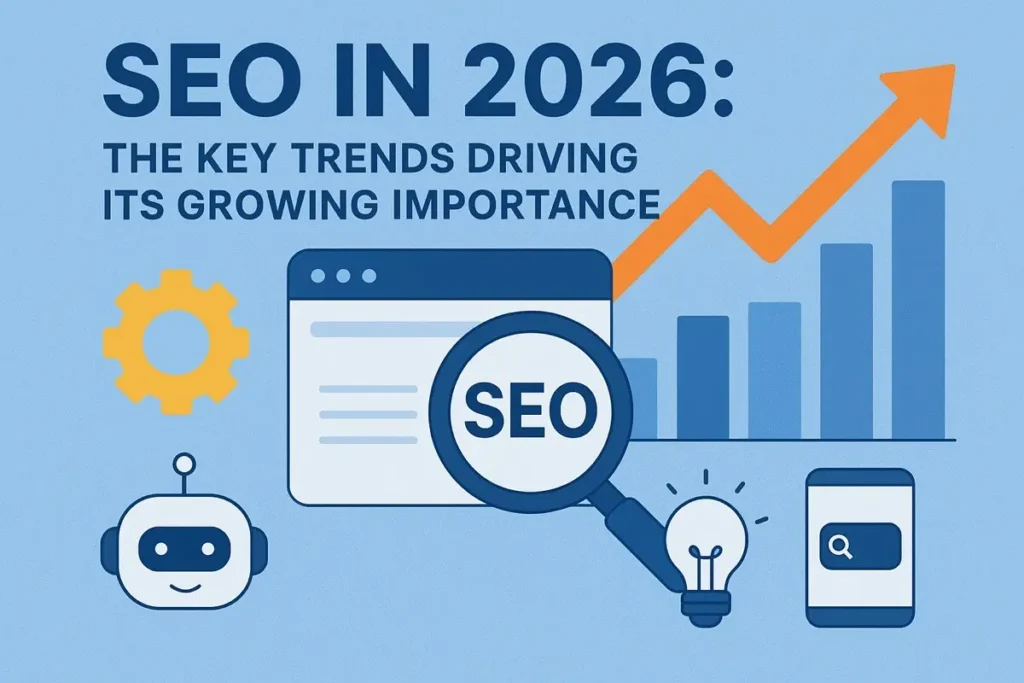
SEO is no longer simply a technique used to improve rankings.
It is an important part of how businesses become discoverable, build credibility, attract relevant traffic, educate potential customers, and create long-term digital visibility.
In 2026, the search landscape is evolving because of AI, changing user behavior, and increasingly competitive digital markets. But the fundamentals remain clear: create useful content, understand your audience, build a technically sound website, and make it easy for both people and search engines to understand what you offer.
Businesses that invest in SEO today are not simply trying to get more clicks tomorrow. They are building a digital asset that can continue supporting their marketing and growth over time.
Whether you’re a startup, local business, ecommerce company, or established brand, the question is no longer “Do I need SEO?”
The better question is:
“How can I use SEO to build a stronger business in 2026 and beyond?”
If you’re ready to turn search visibility into measurable business growth, Brands Barks can help you build a strategy around SEO, paid advertising, lead generation, content, social media, and performance marketing. Brands Barks
FAQs
Is SEO still important in 2026?
Yes. SEO remains important because it helps businesses make their websites and content more discoverable through search. Google has also stated that SEO best practices remain foundational as its Search experience evolves to include generative AI features.
How long does SEO take to show results?
SEO results vary depending on the website, competition, industry, technical condition, content quality, and strategy. Google notes that some changes may take weeks or several months to show an impact in Search.
Can small businesses benefit from SEO?
Absolutely. Small businesses can use targeted SEO strategies to reach specific audiences, locations, services, and search queries without competing only on the broadest keywords.
Is SEO better than paid advertising?
SEO and paid advertising serve different purposes. SEO can support long-term organic visibility, while paid advertising can provide faster access to targeted traffic. Many businesses benefit from using both as part of a broader marketing strategy.
Does SEO only mean using keywords?
No. Modern SEO involves much more than keywords. It includes content quality, website structure, technical performance, internal linking, indexing, user experience, relevant links, and making content understandable to search engines and users. Google specifically advises against keyword stuffing.
Can SEO help generate leads?
Yes. SEO can attract people who are actively searching for products, services, or solutions. When relevant organic traffic reaches well-optimized landing pages and service pages, it can contribute to inquiries, leads, and sales.